How to Start Forex Trading with a Systematic Market-Based Approach
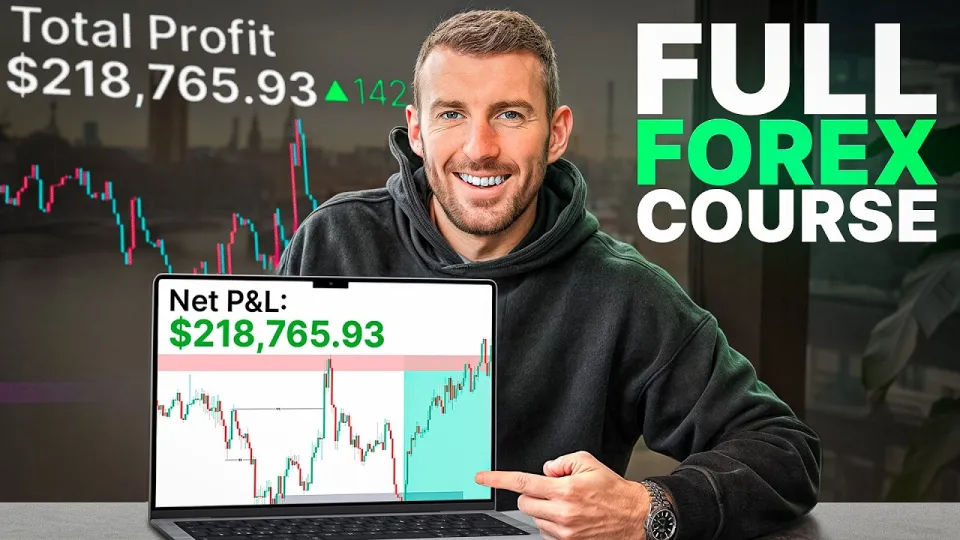
Video: Beginners Guide To Forex Trading In 2026 (+3 hours)
Need articles like this for your video? They help promote it on YouTube and Google — order them in the Telegram bot @sat_sit_bot. The bot writes and publishes the articles itself (with your YouTube video embedded) on popular topical websites (no ads). Free trial — 50 articles.
· based on the channel Matt Donlevey - Photon Trading
Forex trading is the practice of speculating on the exchange rate between two currencies through a broker, and the fastest route into it is a systematic process rather than a pile of indicators. You start by learning how quotes, spreads and order flow actually move price, then build one written strategy with defined entries, exits and risk per trade, and only then add money management and psychology. Matt Donlevey - Photon Trading covers exactly this path in a three-hour beginner walkthrough, and the free Photon Trading course plus cheatsheets is available at the free training page.
What forex trading actually is and who you are trading against
Forex is a decentralized over-the-counter market where banks, funds, brokers and retail traders exchange currencies in pairs, and there is no single central exchange setting one official price. When you buy EUR/USD you are simultaneously buying euros and selling US dollars, and your broker quotes you two prices: the bid at which you can sell and the ask at which you can buy. The gap between them is the spread, which is your first unavoidable cost.
Retail access works through two main models. In the first, your broker passes your order to liquidity providers and earns from the spread or a commission. In the second, the broker takes the other side of your trade, which is why regulation, execution quality and cost transparency matter more than banner promises. Before anything else, check that the broker is supervised by a recognized regulator, holds client funds in segregated accounts and publishes its spreads and commissions clearly.
Three practical points define the beginner's starting position:
- You trade pairs, not single currencies, so every position is a relative bet between two economies.
- Your position size in lots determines how much each pip of movement is worth, and that number decides your risk.
- Leverage is not free capital; it multiplies both gains and losses and is the most common reason small accounts disappear.
Why price moves and why chart shapes alone explain nothing
Technical analysis has a poor reputation because geometric patterns describe the shape of price after the fact without explaining the mechanism behind the move. The mechanism is order flow: resting limit orders form liquidity at certain prices, aggressive market orders consume it, and price travels from one pool of liquidity to the next. Market microstructure, the order book, auction market theory and order flow are the four concepts that turn a chart from a drawing into a map of where business was done.
In practice this means a level matters because buyers or sellers left unfilled orders there, not because a line looks clean. A candle is simply a record of where price opened, closed and how far it stretched in between, and a single candle carries little information until you know what liquidity sat above or below it. Auction market theory adds the idea that price rotates around areas of accepted value and moves quickly through areas of rejection, which is why sharp displacement candles often leave gaps that later get revisited.
Reading market structure across timeframes
Market structure is the sequence of swing highs and swing lows, and it tells you which side currently controls the auction. An uptrend prints higher highs and higher lows; a downtrend prints lower highs and lower lows; a range prints neither consistently. The practical skill is to classify the structure you are looking at before you consider any trade, because the same candle pattern means opposite things in a trend and in a range.
Three structure types are worth separating:
- Trending structure, where you look for continuation entries on pullbacks toward the origin of the last impulse.
- Ranging structure, where the edges of the range act as reference points and the middle is a low-quality zone.
- Transitional structure, where a break of the last swing point signals a possible shift and demands patience until the new sequence confirms.
Multi-timeframe analysis connects these views. You mark structure on a higher timeframe to establish direction, then drop to a lower timeframe to find the precise area where a trade can be staged. Premium and discount pricing refines this further: within a leg, buying in the lower half and selling in the upper half improves the risk-to-reward arithmetic of every entry.
Supply, demand and liquidity concepts in practice
Supply and demand zones are areas where price previously left with force, and they matter because unfilled orders are likely to remain there. A valid zone usually shows a strong departure, minimal overlapping candles inside it and a clear origin point; a messy, choppy base with dozens of candles is a weak zone. Liquidity concepts complete the picture: equal highs, equal lows and obvious round numbers attract resting stop orders, and price frequently trades into those pools before reversing.
This is why entries are staged rather than guessed. A common sequence is to identify a higher-timeframe zone, wait for price to sweep an obvious liquidity pool, and then look for a lower-timeframe shift in structure that confirms the reaction. Trade management follows the same logic: you move risk to breakeven or take partials only at structural references, not at arbitrary pip counts, and you accept that some setups fail by design.
Money management, trade plans and backtesting
Money management is the part that keeps you in the game long enough for a strategy to prove itself. A workable default for a new account is risking a small, fixed percentage of equity per trade, commonly cited between 0.5% and 2%, with the position size calculated from the stop distance rather than chosen by feel. Risk-to-reward should be defined before entry, and a maximum daily or weekly loss limit prevents one bad session from erasing a month of progress.
A trade plan converts all of this into written rules: which pairs and sessions you trade, which timeframe sets direction, what qualifies as a setup, where the stop and target sit, how much you risk, and what makes you stop for the day. Backtesting then tests those rules on historical data, ideally on a decent sample of trades and with realistic spreads and commissions, before any live capital is committed. Choosing a broker and understanding trading costs belong in the same document, because spread, commission and swap can quietly turn a profitable method into a losing one.
Common beginner doubts and mistakes
Most beginner problems repeat across accounts, and the recurring doubts are worth answering directly. One is speed: a dense, fast-paced explanation can feel impossible to follow, so the practical fix is to pause on one topic, write the rules down and test them before moving to the next section rather than watching everything in one sitting. Another is strategy hopping, where a trader switches methods after three losing trades and never collects enough data to judge any of them.
The three mistakes that cost the most are oversized risk, trading without a written plan and skipping the journal. A journal records the setup, the reason for entry, the result and the emotional state, and after a few dozen entries it shows which conditions actually produce your edge. Psychology work comes after that point: discipline is much easier to build around a strategy you have already tested than around one you are still hoping will work. Execution is the final mechanical step, and it should be boring, because the decision was made in the plan, not in the moment.
Useful links
- Free Photon Trading course and cheatsheets: https://www.photontradingfx.com/free-training?el=beginnersguide&htrafficsource=YT
- Photon Mentorship program: https://www.photontradingfx.com?el=beginnersguide&htrafficsource=yt
- Free Telegram channel with analysis and trade recaps: https://t.me/photontrading
- Instagram: https://www.instagram.com/photontrading/
Final thoughts on building a forex process
Forex rewards a repeatable process far more than a clever prediction, and the material above is a sequence rather than a menu: understand the mechanics of price, define structure and liquidity rules, then wrap them in risk limits and a journal. The three-hour beginner guide from Matt Donlevey - Photon Trading is a useful spine for that sequence because it connects market dynamics, strategy development and execution in one place instead of scattering them across unrelated clips. Work through it slowly, write your rules down and backtest them before risking real money. If you want the structured starting point, begin with the free Photon Trading course and cheatsheets and build your plan around it.
Key takeaways
- Forex is a decentralized over-the-counter market where currencies are quoted in pairs such as EUR/USD, and retail traders access it through brokers rather than a single exchange.
- Price moves because of order flow: bids, asks, spread and the order book show how resting liquidity and aggressive orders interact at each level.
- Auction market theory explains that price seeks areas where trade can occur, so supply and demand zones and liquidity pools matter more than geometric chart patterns.
- A complete forex plan needs four parts: market structure and entries, trade management, money management and a written trade plan with backtesting.
- Typical beginner losses come from oversized risk, no journal and strategy hopping; journaling and psychology work only after a tested edge exists.
Questions & answers
How much money do I need to start trading forex?
You can open many accounts with a few hundred dollars, but the meaningful question is how much you can risk per trade without stress. If you risk 1% of a $500 account, that is $5 per trade, which limits how much you can learn from results. Many beginners therefore practice on a demo account until their written rules produce a consistent sample of trades.
Is technical analysis useless for forex?
No, but pattern recognition alone explains little because shapes do not describe why price moved. Technical analysis becomes useful when it is combined with market microstructure, order flow and liquidity: a level matters because orders sit there, not because a line looks neat. Treat charts as a map of where business was done.
How long does it take to become consistently profitable?
There is no fixed timeline, and anyone promising a number is guessing. Progress depends on how quickly you settle on one tested strategy, how honestly you journal and how strictly you control risk. A realistic approach is to measure months of rule-following and a documented sample of backtested and live trades rather than calendar time.
Should I learn psychology before or after building a strategy?
Build and test the strategy first, then work on psychology. Discipline is far easier when you have evidence that your rules have an edge, because losses stop feeling like proof the method is broken. Psychology training matters most once a tested edge exists and the challenge becomes executing it consistently.
Source: Beginners Guide To Forex Trading In 2026 (+3 hours) · Markdown version